
You’ve decided your business needs a new website. You’ve contacted a few development companies, received different quotations, and now you’re trying to work out which one deserves your trust.
One company promises a beautiful design in seven days. Another talks about SEO, performance, and integrations. A third offers almost everything for half the price.
How do you compare them when they aren’t necessarily offering the same thing?
Choosing a web development company in Egypt isn’t simply about finding the most attractive design or the lowest quotation. You’re choosing the people responsible for building something your customers may use every day.
A poor decision can leave you with a website that’s difficult to update, expensive to maintain, or disconnected from how your business actually operates.
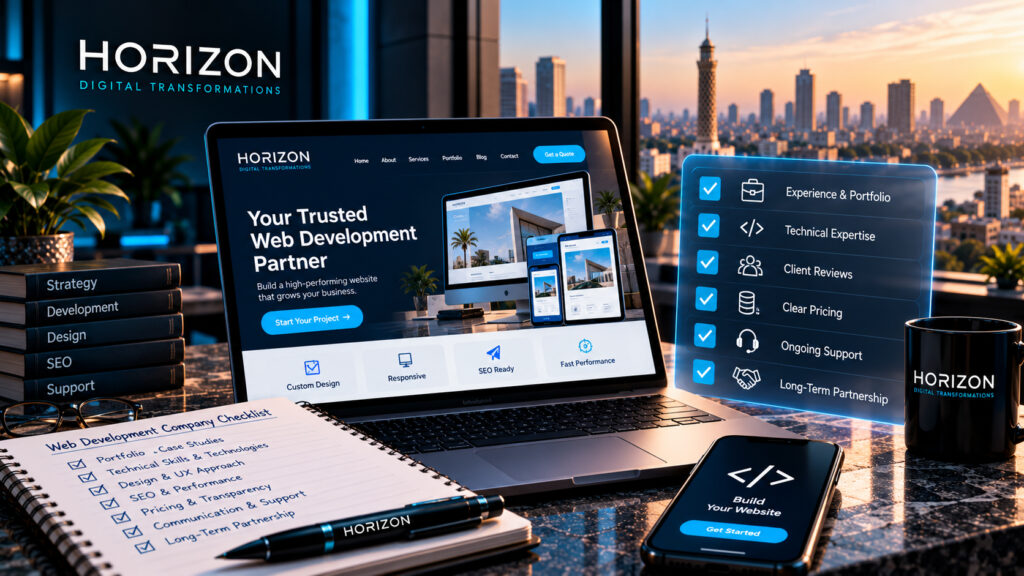
This guide gives you a practical checklist to evaluate web development companies, compare proposals, and make a more confident decision before signing a contract.
Before Comparing Companies, Define What Your Website Needs to Achieve
A useful first step is to write down what success looks like for your website.
Not the colors. Not the animations. Not even the number of pages.
Start with its business purpose.
For example:
- A medical clinic may need patients to understand its services and request appointments.
- A real estate company may need to present properties and generate qualified inquiries.
- A manufacturer may need a professional corporate website that attracts distributors.
- A retail business may need an online store with payments, delivery options, and inventory management.
- A service company may need to turn search traffic into consultations or quotation requests.
These are different projects, even if they all involve website development.
Before speaking with an agency, answer five questions:
- Who is the website for?
- What should visitors do when they arrive?
- What information or functionality must be available?
- Who will manage the website after launch?
- How will you know whether the website is helping your business?
You don’t need a complete technical specification.
A clear understanding of your business requirements is enough to make the first conversation considerably more productive.
1. Review Real Projects, Not Just Attractive Portfolio Images
Almost every web development company has a portfolio.
But a portfolio should help you evaluate what a company can actually deliver, not simply show you what looks impressive in a presentation.
Start by looking for projects that resemble yours in purpose or complexity.
If you’re building an e-commerce store, review actual online stores. If you need a corporate website, examine how the agency organizes information and presents business services.
What should you check?
Open a few projects and ask yourself:
- Does the website clearly explain what the business offers?
- Is it easy to navigate?
- Does it work properly on mobile devices?
- Are the contact forms and important buttons functional?
- Is the content organized logically?
- Does the website feel appropriate for the business it represents?
Try using the website as a customer rather than evaluating it as a designer.
You can also ask the agency what it contributed to each project. Did it handle design, development, content, integrations, or only a particular part of the work?
A professional portfolio should provide context, not just screenshots.
Practical tip: If possible, ask to see a live project with requirements similar to yours. If a live link isn’t available, request an explanation or demonstration rather than assuming the work is unsuitable.
2. Look for a Company That Understands Your Business
The quality of the first conversation can tell you a great deal about how a development team approaches projects.
Imagine speaking with two agencies.
The first immediately asks which colors you prefer and how many pages you want.
The second asks about your customers, current challenges, competitors, internal processes, and what you want visitors to do.
Both conversations may eventually lead to a quotation, but the second gives the team more information to recommend an appropriate solution.
A business-focused discovery process should explore:
- Your target customers and market
- Your main products or services
- The purpose of the website
- Your existing digital presence
- Content and language requirements
- Any necessary integrations
- Your budget and timeline
This doesn’t mean every project requires weeks of strategy workshops.
It means the development company should understand the problem before recommending the solution.
A good website should fit the business—not force the business to adapt to an unsuitable template.
3. Ask Who Will Actually Design and Develop Your Website
When you’re comparing agencies, it’s worth understanding how each company handles its work.
Some have in-house designers and developers. Others use freelancers, external partners, or a combination of different teams.
None of these arrangements automatically determines quality.
What matters is accountability.
Ask who will be responsible for:
- Project management and communication
- Website design
- Development and integrations
- Content preparation
- Testing and quality assurance
- Launch and technical support
You should also know who to contact when you need an update or when something doesn’t work as expected.
If several people or companies are involved, ask how the work is coordinated.
Clear responsibilities reduce misunderstandings and make it easier to resolve issues throughout the project.
4. Evaluate the Technology Based on Your Requirements
You don’t need to become a developer to choose a development company.
But you should understand why a particular technology is being recommended.
For many business websites, WordPress can be a practical choice because it supports content management, customization, and a broad ecosystem of tools.
For online stores, WooCommerce or another established e-commerce platform may meet the requirements without building everything from scratch.
More specialized projects may require custom development.
The important question is:
Why is this platform suitable for my business?
Ask the agency to explain:
- How easily your team can update content
- Whether the platform supports your required features
- What happens when your business grows
- Whether third-party tools can be integrated
- What maintenance will be required
- Whether you can move to another provider later
Be cautious when a company recommends a technology without first understanding your requirements.
Likewise, don’t assume custom development is automatically better than a well-implemented existing platform.
The right solution is the one that supports your needs without unnecessary complexity.
5. Make Sure SEO Is Considered During Development
A website can look excellent and still be difficult for search engines to discover or understand.
That’s why search engine optimization shouldn’t be treated as something that only begins after launch.
Your development company should understand the technical foundations that support search visibility.
These include:
- Clear website structure and navigation
- Descriptive, readable page URLs
- Appropriate page titles and headings
- Mobile-friendly layouts
- Indexable content
- Proper internal linking
- XML sitemaps and canonical URLs where appropriate
- Reasonable loading performance
- Correct redirects when replacing an existing website
For businesses targeting customers in Egypt, the agency should also understand whether your audience searches in Arabic, English, or both.
An Arabic version of a website requires more than translating a few headings. Language, navigation, content quality, and right-to-left layouts need proper attention.
What if you’re replacing an existing website?
This deserves special attention.
If your old website already receives Google traffic, changing its URLs without a migration plan can cause valuable pages to become inaccessible.
Ask how the agency will preserve relevant URLs, handle permanent redirects, review existing content, and verify the new website after launch.
Google provides official guidance for website migrations, including URL mapping, redirects, testing, and monitoring.
Important: No responsible development company can guarantee a specific Google ranking simply because it builds your website.
Technical SEO creates a stronger foundation, but organic search performance also depends on content, competition, relevance, and other factors.
6. Test Mobile Usability, Speed, and Accessibility
Your website needs to work for real visitors—not just look impressive on a designer’s large monitor.
When reviewing an agency’s previous work, open a few websites on your phone.
Try completing a normal task.
Can you find the services? Read the text comfortably? Open the menu? Submit an inquiry without difficulty?
Also pay attention to:
- Text readability
- Button sizes and spacing
- Image loading
- Navigation behavior
- Form usability
- Layout stability
- Keyboard accessibility where relevant
You can use Google’s PageSpeed Insights to investigate performance.
However, don’t judge a company entirely by a single automated score. Results can vary based on the page, device, connection, third-party scripts, and testing conditions.
Instead, ask how the company approaches performance and which checks it performs before launch.
A good development process should include testing across relevant devices and browsers, not just a final visual review.
7. Compare Website Quotations Based on Scope, Not Price Alone
This is one of the most important steps when choosing a web development company in Egypt.
Two agencies may quote very different prices because they’re proposing different deliverables.
For example, one quotation might include a five-page website using a prebuilt template.
Another might include content structure, customized design, integrations, SEO foundations, analytics setup, testing, and post-launch support.
Both may be valid offers.
But they aren’t directly comparable.
What should a website development quotation include?
| Item | What You Should Clarify |
|---|---|
| Pages and structure | Which pages and sections are included? |
| Design | Template-based or customized? |
| Content | Who writes, edits, and uploads the content? |
| Features | Which forms, integrations, and functions are included? |
| Mobile experience | What responsive testing is provided? |
| SEO setup | Which technical and on-page foundations are included? |
| Hosting and domain | Included, separate, or client-provided? |
| Timeline | What are the milestones and dependencies? |
| Revisions | How many revisions are included, and at which stages? |
| Maintenance | What support is available after launch? |
Also ask what happens if you request additional features during development.
Will you receive a revised quotation? How will the changes affect the timeline?
A clear scope protects both sides and helps prevent disagreements later.
If you’re still working out your budget, read our guide to website development costs in Egypt to understand what affects pricing before comparing proposals.
8. Confirm Website Ownership and Access Before Signing
This is easy to overlook when you’re excited about launching a new website.
But you should know exactly what your business will own and control when the project is completed.
Clarify who controls:
- The domain registration
- Hosting account
- Website administrator access
- Website files and database
- Design assets and licensed materials
- Analytics and Search Console accounts
- Third-party subscriptions and integrations
Ownership can depend on your contract and the licenses used in the project.
For example, a business may own its website content and custom deliverables while continuing to use separately licensed themes, plugins, fonts, or software.
Ask the agency to explain these distinctions in writing.
You should also understand how the website could be transferred to another provider if necessary.
The objective isn’t to assume the agency will become a problem.
It’s to make sure your business retains appropriate control over an important digital asset.
9. Understand the Development Process and Timeline
A professional development process doesn’t have to be complicated.
But it should be clear enough that you understand what happens next.
A typical website project may include three broad stages.
Discovery and Planning
The team gathers requirements, discusses goals, defines the website structure, and agrees on the project scope.
Design and Development
The website takes shape through design, development, content integration, and functional implementation.
You should know when feedback is expected and which changes are possible at each stage.
Testing and Launch
The team checks important functionality, reviews the website on relevant devices, resolves identified issues, and prepares it for launch.
For a replacement website, launch planning should also include migration and redirect checks where applicable.
Before signing, ask:
- What are the project milestones?
- What do you need to provide, and when?
- Who approves each stage?
- What happens if feedback or content is delayed?
- How will progress be communicated?
A realistic timeline is more useful than an impressive deadline that nobody can explain.
10. Ask What Happens After the Website Goes Live
Launch day isn’t the end of your website’s useful life.
Your business may need content updates, technical maintenance, new features, hosting support, or help resolving unexpected problems.
Before choosing a company, ask about its post-launch arrangements.
Some useful questions include:
- Is there a period for fixing issues identified after launch?
- Are software updates included?
- Who manages backups?
- Is hosting support included?
- How are urgent technical issues handled?
- Can we request additional features later?
- Is ongoing support charged separately?
Make sure the answers are documented.
Don’t assume that the phrase “technical support included” means unlimited changes or continuous maintenance.
The scope, duration, response arrangements, and exclusions should be clear.
11. Watch for These Warning Signs
Not every concern means you should immediately reject a company.
But some issues deserve clarification before you make a financial commitment.
Unclear quotations: A price without a defined scope makes comparison difficult.
No relevant work to demonstrate: Ask for live examples, demonstrations, or other credible evidence of experience.
Guaranteed Google rankings: Search visibility cannot be guaranteed through website development alone.
Unclear ownership: You should understand your rights and access before signing.
No testing process: A website should be checked before customers start using it.
Unrealistic deadlines: Ask how the timeline was calculated and what assumptions it depends on.
No explanation of ongoing costs: Hosting, subscriptions, maintenance, and integrations may continue to cost money after launch.
Pressure to decide immediately: A reasonable provider should give you enough information to evaluate the proposal.
The goal isn’t to find a company that makes the biggest promises.
It’s to find one that can explain its recommendations, demonstrate relevant capabilities, and commit to a clear scope.
A Practical Checklist for Comparing Web Development Companies
Use this checklist when reviewing your shortlisted agencies.
| Evaluation Criteria | Company A | Company B | Company C |
|---|---|---|---|
| Understands our business goals | ☐ | ☐ | ☐ |
| Has relevant portfolio projects | ☐ | ☐ | ☐ |
| Explains its technical recommendations | ☐ | ☐ | ☐ |
| Provides a clear written scope | ☐ | ☐ | ☐ |
| Includes mobile and usability testing | ☐ | ☐ | ☐ |
| Understands technical SEO requirements | ☐ | ☐ | ☐ |
| Clarifies ownership and access | ☐ | ☐ | ☐ |
| Defines project milestones | ☐ | ☐ | ☐ |
| Explains post-launch support | ☐ | ☐ | ☐ |
| Provides transparent pricing | ☐ | ☐ | ☐ |
You can also rate each company from 1 to 5 on the criteria that matter most to your business.
For example, a business replacing an established website may give greater weight to SEO migration experience.
An online retailer may prioritize checkout functionality, integrations, and ongoing support.
A new professional services company may care more about content structure, credibility, and lead generation.
There isn’t one universal scoring formula.
Your priorities should reflect your project.
Questions to Ask a Web Development Company Before Hiring
If you only have time for one meeting, take these questions with you:
- Have you developed websites for businesses with requirements similar to ours?
- Can you show us relevant completed projects?
- Who will work on our website?
- Which platform would you recommend, and why?
- What exactly is included in your quotation?
- What will we need to provide during the project?
- How do you handle revisions and additional requests?
- What SEO and performance checks are included?
- How will you test the website before launch?
- Who will control the domain, hosting, and website accounts?
- What happens if we need to move to another provider?
- What support will be available after launch?
You don’t need perfect technical answers to every question.
You need clear, relevant answers that you can understand and compare.
Should You Hire a Freelancer or a Web Development Agency?
Both options can work well.
A skilled freelancer may be a suitable choice for a relatively straightforward website with clearly defined requirements.
An agency may be more appropriate when your project requires several disciplines, such as strategy, design, development, content, integrations, and marketing.
Consider the complexity of your project, how much coordination you can manage internally, and the level of continuity you need.
Don’t choose an agency simply because it has a larger team.
And don’t choose a freelancer only because the quotation is lower.
Choose the working arrangement that gives your project the right expertise, accountability, and support.
How HORIZON Approaches Website Development
At HORIZON For Digital Transformations, we believe website development should begin with understanding the business behind the project.
That includes discussing what the website needs to achieve, how visitors will use it, and which features are genuinely necessary.
Our work covers business websites, e-commerce stores, and web solutions developed around different operational requirements.
We bring together design, development, and related digital capabilities to support projects from planning through launch.
You can explore our Website Development & E-Commerce Services to understand the types of solutions we build, or visit Our Work to see selected projects.
And if you’re comparing development partners, we’d be happy to discuss your requirements and help you understand the appropriate scope before moving forward.
Frequently Asked Questions
How do I choose the best web development company in Egypt?
Start by defining your business requirements. Then compare companies based on relevant work, technical approach, communication, pricing transparency, ownership terms, and post-launch support. The best choice is the company that fits your specific project—not necessarily the largest or cheapest provider.
What should I ask before hiring a website development company?
Ask about previous projects, the proposed technology, included deliverables, timeline, revisions, SEO foundations, website ownership, and ongoing support. Request written clarification for anything that affects cost or responsibility.
Is it better to hire a freelancer or a web development agency?
It depends on your requirements. Freelancers can be suitable for smaller, well-defined projects. Agencies may be helpful when several specialists need to coordinate on design, development, integrations, content, and marketing.
Should SEO be included in website development?
Basic technical SEO considerations should be addressed during development. However, ongoing SEO strategy, content production, and search performance improvements may be separate services. Always confirm what the quotation includes.
How much does it cost to hire a web development company in Egypt?
Costs vary according to website type, design requirements, features, integrations, content, and support. Rather than comparing prices alone, request a detailed scope from each provider and calculate the total cost of ownership.
Can I change my website development company after launch?
Usually, yes, but the ease of transferring a website depends on its technology, licensing, contractual terms, and access arrangements. Confirm ownership, administrator access, hosting, and handover conditions before starting the project.
Final Thoughts: Choose the Partner, Not Just the Proposal
A website development project is a business investment.
The right company should help you understand what you’re building, why it matters, what it will cost, and what happens after launch.
Review real work. Ask questions. Compare written proposals. Clarify ownership and support.
Most importantly, choose a team that understands your requirements and can explain how its approach supports them.
Planning a new website or considering a redesign?
Tell HORIZON about your project, your business goals, and what you’re looking to achieve.
