
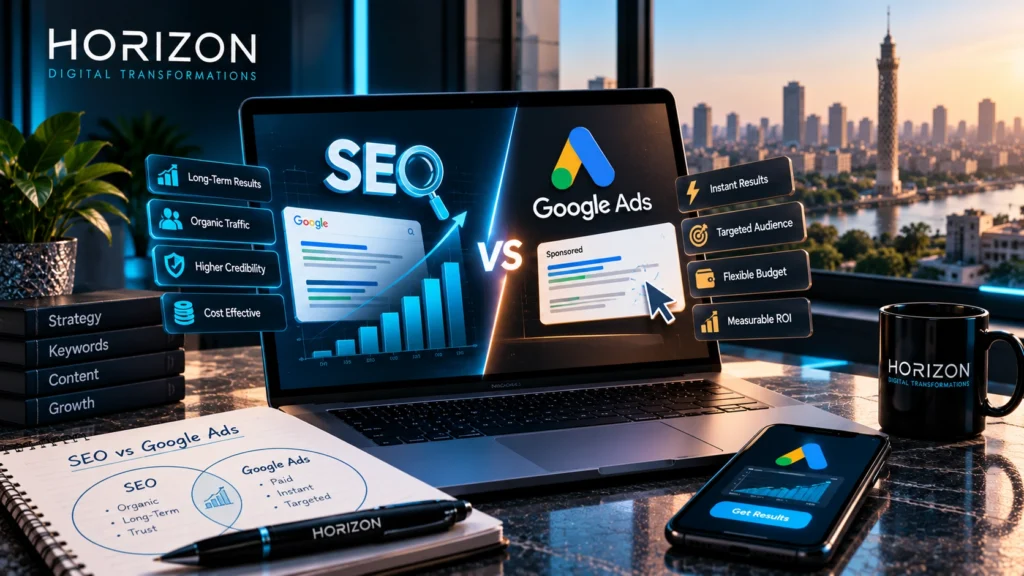
A potential customer searches Google for exactly what your business sells.
You want to be there.
There are two obvious ways to make that happen: earn visibility in Google’s organic search results through SEO, or pay to compete for advertising space through Google Ads.
That sounds like a simple choice.
It isn’t.
Google Ads can start putting your business in front of relevant searches soon after a campaign is launched, but that visibility is tied to advertising spend and campaign performance.
SEO usually takes longer. You’re building pages, content, technical foundations, and authority that need time to earn organic visibility. But successful SEO can continue attracting relevant searches without paying for every individual click.
In 2026, there’s another layer to the decision. Google Search itself has changed. AI Overviews and AI Mode are becoming part of how people discover and evaluate information, while Google Ads is becoming increasingly AI-driven through products such as AI Max and Smart Bidding.
So the useful question isn’t:
“Is SEO better than Google Ads?”
It’s:
“What does my business need search marketing to achieve right now — and what should it build for the future?”
Let’s break that down.
SEO vs Google Ads: The Short Answer
If your business needs to generate targeted visibility quickly, test an offer, promote a time-sensitive campaign, or reach people searching with strong commercial intent, Google Ads can be useful.
If you want to build sustainable organic visibility, develop authority around the subjects your customers search for, and create a search presence that isn’t dependent on paying for every click, SEO serves a different purpose.
And for many businesses, the most practical strategy isn’t choosing one forever.
It’s understanding when each channel should do the job.
Here’s the basic difference:
| SEO | Google Ads | |
|---|---|---|
| Traffic Source | Organic search | Paid advertising |
| Speed | Usually gradual | Can begin quickly |
| Cost Model | Investment in content, technical work and optimization | Advertising budget + management/creative costs |
| Pay Per Click | No | Often, depending on campaign type |
| Visibility | Earned through search systems | Determined through ad eligibility and auction |
| Stops When Budget Stops? | Not automatically | Paid campaign traffic generally does |
| Long-Term Value | Can compound over time | Primarily tied to active campaigns |
| Control | Lower immediate control | High campaign-level control |
| Testing | Slower | Faster |
| Best Role | Sustainable search visibility | Immediate, controllable acquisition |
Neither column is universally better.
The right mix depends on your business.
What Is SEO?
SEO — search engine optimization — is the process of improving your website and content so they can be discovered, understood, indexed, and potentially ranked by search engines for relevant searches.
That can involve:
- Technical website improvements
- Keyword and search-intent research
- Website structure
- Service and product pages
- Useful informational content
- Internal linking
- On-page optimization
- Local search optimization
- Digital authority and reputation
- User experience
- Performance
- Continuous analysis and improvement
The objective isn’t simply to “rank #1.”
Good SEO connects your business with searches that actually matter.
A company selling accounting software, for example, doesn’t need traffic from everyone interested in accounting.
It needs visibility around the problems, questions, comparisons, and buying decisions its potential customers are searching for.
And SEO remains relevant even as Google Search becomes more AI-driven. Google states that the same core SEO best practices continue to apply to AI Overviews and AI Mode; there isn’t a separate technical trick required to appear in those experiences.
What Is Google Ads?
Google Ads allows businesses to pay for advertising opportunities across Google’s advertising ecosystem.
For Search campaigns specifically, advertisers can target relevant demand and compete for ad visibility when people search.
But paying more doesn’t automatically guarantee the highest position.
Google explains that its Search ad auction considers factors including the advertiser’s bid, ad and landing-page quality, Ad Rank thresholds, the context of the search, expected impact of assets, and auction competitiveness.
That matters because successful Google Ads management isn’t simply:
Choose keyword → set budget → get customers.
You still need the right targeting, offer, ad, landing page, conversion tracking, bidding strategy, and ongoing optimization.
Google Ads can buy an opportunity to reach someone.
It can’t make a weak offer compelling or a poor website convert.
The Biggest Difference: Time
This is where the two channels behave very differently.
Google Ads Can Move Quickly
Once a campaign is approved and running, your ads can become eligible to appear for relevant searches relatively quickly.
That makes paid search particularly useful when you’re:
- Launching a new business
- Promoting a new product or service
- Testing a new market
- Running a limited-time offer
- Entering a competitive category
- Trying to generate leads while your organic presence is still developing
You don’t need to wait for a page to build organic rankings before testing whether people respond to your offer.
But being live doesn’t guarantee results.
The campaign still has to compete successfully and convert the traffic it receives.
SEO Needs More Patience
SEO doesn’t have an “on” button.
A new article published today may not immediately generate meaningful organic traffic.
Search engines need to discover and understand content, and competitive rankings can require improvements across the website as well as authority and time.
That makes SEO less suitable when someone says:
“We need 50 leads next week.”
But that’s not what SEO is designed to solve.
SEO is about building an asset that can make your business discoverable across relevant searches over time.
The Second Difference: How You Pay
You’ll sometimes hear:
“SEO is free and Google Ads is paid.”
That’s misleading.
Organic clicks don’t have a direct CPC charge.
But serious SEO still costs money.
Someone needs to research, plan, write, design, develop, optimize, measure, update, and improve the website and its content.
So the more accurate distinction is:
SEO invests in earning organic visibility.
Google Ads invests directly in advertising visibility and traffic opportunities.
With many Google Search campaigns, advertisers pay based on clicks. Google notes that actual CPC is determined through the ad auction and may be lower than the advertiser’s maximum CPC bid.
That distinction changes how you think about ROI.
What Happens When You Stop Paying?
This is one of SEO’s most important advantages — but it is also commonly exaggerated.
If you pause a Google Ads campaign, that campaign stops buying new paid visibility.
SEO doesn’t disappear because you stop spending on it for a month.
Pages you’ve created can continue appearing in search and attracting visitors.
But don’t translate that into:
“SEO lasts forever.”
Rankings can fall.
Competitors improve.
Search behavior changes.
Products change.
Information becomes outdated.
Technical problems appear.
Google’s search experiences evolve.
SEO assets can continue producing value, but they still need maintenance and improvement.
Think of SEO less like renting clicks and more like building digital property that still requires upkeep.
SEO vs Google Ads: Which Generates Better ROI?
There is no credible universal answer.
A business with excellent organic rankings but a poor sales process can waste SEO traffic.
A business with excellent Google Ads targeting but a weak landing page can burn through advertising budget.
Another business might generate highly profitable customers from both.
ROI depends on variables including:
- Customer lifetime value
- Conversion rate
- Gross margin
- Sales cycle
- Keyword competition
- Cost per click
- Cost per acquisition
- Website quality
- Offer quality
- Organic competition
- Content quality
- Lead qualification
- Follow-up and sales performance
That’s why comparing traffic alone isn’t enough.
The better question is:
What does it cost to acquire a qualified customer, and what is that customer worth to the business?
SEO vs Google Ads for High-Intent Searches
Consider someone searching:
“best CRM for construction companies”
versus:
“what is CRM software?”
Those searches represent very different stages of awareness.
Google Ads can be especially useful for capturing commercial searches where the advertiser knows what a conversion may be worth.
SEO can cover a much broader journey.
You might create content around:
- Problems customers are trying to solve
- Educational questions
- Product categories
- Comparisons
- Pricing
- Alternatives
- Case studies
- Service pages
- Buying decisions
That means SEO can help your business become visible before someone is ready to contact a supplier.
And when they finally reach a commercial search, they may already recognize your brand.
Which Gives You More Control?
Google Ads.
By a significant margin.
Advertisers can control or influence things such as:
- Campaign budgets
- Geographic targeting
- Search targeting
- Ad messaging
- Landing pages
- Campaign schedules
- Conversion goals
- Bidding strategies
Campaigns can also be adjusted quickly.
SEO doesn’t work that way.
You can improve a page, but you cannot instruct Google to rank it in position three tomorrow.
Organic search systems decide what appears.
That makes Google Ads useful when control and speed matter.
SEO’s trade-off is that you’re building visibility that isn’t purchased one click at a time.
Which Is Better for Testing a New Offer?
Usually, paid advertising gives you faster feedback.
Imagine launching a new service.
Before spending months building a large content cluster around it, you may want to know:
- Are people searching for it?
- Does our messaging attract clicks?
- Does the landing page convert?
- Which offer gets stronger responses?
- Which locations produce better leads?
A controlled paid campaign can help answer those questions much faster than waiting for organic rankings.
Those findings can then inform your SEO strategy.
This is one reason treating SEO and PPC as completely separate disciplines can waste useful data.
Where SEO Has the Bigger Strategic Advantage
SEO becomes particularly powerful when customers repeatedly search for topics related to your expertise.
A company might have:
- 10 commercial service pages
- 30 useful guides
- 15 case studies
- Comparison articles
- Product/category pages
- Location-specific content where genuinely relevant
Together, those pages can create many different ways for potential customers to discover the business.
One ad campaign doesn’t create that same content footprint.
This becomes even more interesting in 2026 because organic content can potentially surface not only through traditional search results but also as supporting sources in Google’s AI search experiences when eligible. Google explicitly says that pages appearing as supporting links in AI Overviews or AI Mode must be indexed and eligible for Search, and that established SEO fundamentals remain applicable.
So the opportunity around useful organic content has changed.
It hasn’t disappeared.
Where Google Ads Has the Bigger Strategic Advantage
Intent can sometimes be worth more than reach.
Suppose you provide an expensive B2B service and only need a handful of qualified customers each month.
Being able to compete immediately for highly relevant commercial searches can be extremely valuable.
You can also respond quickly.
Demand changed?
Adjust the campaign.
A service is unavailable?
Pause it.
A particular landing page is converting?
Send more appropriate traffic toward it.
SEO simply doesn’t offer that degree of immediate control.
Google Ads Is Becoming More AI-Driven in 2026
This is one area where an older SEO-vs-PPC article can become outdated quickly.
Google continues expanding AI across Search advertising.
AI Max for Search campaigns uses Google’s AI to expand query matching and help adapt creative to relevant searches while providing controls for advertisers. Google announced in 2026 that AI Max had moved beyond beta and continued adding controls and testing capabilities.
Google’s Smart Bidding also uses AI at auction time to optimize bids toward conversion or conversion-value objectives.
That doesn’t remove the marketer from the process.
It changes the work.
Clean conversion data, useful landing pages, clear business objectives, sensible campaign structure, strong creative inputs, and understanding what constitutes a valuable customer become increasingly important when automation is making more decisions.
SEO Is Changing Because Search Is Changing Too
SEO in 2026 isn’t just ten blue links.
Google now incorporates experiences such as AI Overviews and AI Mode into Search.
But this doesn’t mean businesses need to abandon SEO and start chasing a completely separate “AI optimization” formula.
Google’s current guidance is surprisingly straightforward: foundational SEO practices still apply, and businesses should focus on valuable, unique, non-commodity content rather than searching for shortcuts designed specifically for generative AI results.
That’s an important distinction.
The objective isn’t:
“Write content for AI.”
It’s:
Create something useful enough to deserve being found, referenced, and visited — regardless of how the search interface evolves.
Should a New Business Start With SEO or Google Ads?
For many new businesses, there is a strong argument for working on both — but for different reasons.
Google Ads can help test demand and start generating visibility while the organic presence is still weak.
At the same time, SEO foundations can be built into the website from the beginning:
- Search-friendly website structure
- Strong service pages
- Useful content
- Internal linking
- Technical foundations
- Search measurement
Waiting a year before thinking about SEO can mean starting that compounding process a year late.
On the other hand, expecting SEO to generate immediate sales for a brand-new website can create unrealistic expectations.
Use each channel for what it does well.
When SEO May Deserve More of Your Budget
SEO may deserve greater emphasis when:
- Customers regularly research your products or services through search
- You have expertise that can become useful content
- Your business benefits from long-term visibility
- Paid clicks in your market are expensive
- You want to build authority around a category
- Your website has significant untapped organic potential
- Customers have a longer research journey
- You can consistently invest in quality content and optimization
The word consistently matters.
Publishing three articles and abandoning SEO isn’t much of a strategy.
When Google Ads May Deserve More of Your Budget
Paid search may deserve greater emphasis when:
- You need to generate demand quickly
- You’re launching something new
- You have a proven landing page or offer
- You can measure conversions reliably
- Customer value supports the acquisition cost
- You need precise campaign control
- You’re testing a new market
- Searchers already demonstrate strong buying intent
But don’t scale an advertising campaign simply because it generates clicks.
Scale when you understand what happens after the click.
SEO and Google Ads Work Better When They Share Data
This is where the “SEO vs Google Ads” debate becomes less useful.
Imagine your Google Ads data shows that a particular search theme repeatedly generates qualified leads.
That can inform:
- New organic content
- Service-page improvements
- Website messaging
- Keyword priorities
Meanwhile, SEO can reveal questions and search themes customers care about, which can inform:
- Paid keywords
- Ad messaging
- Landing pages
- New offers
And both channels benefit from improvements to the website itself.
Better landing pages.
Clearer positioning.
Faster performance.
Stronger calls to action.
More useful content.
SEO and Google Ads may acquire traffic differently, but eventually they send people into the same business experience.
A Practical Way to Split Your Search Marketing Investment
Don’t start with an arbitrary percentage such as:
50% SEO / 50% Google Ads.
Start with the business situation.
Scenario 1: New business that needs leads now
Use paid search to test commercial demand while building SEO foundations in parallel.
Scenario 2: Established business heavily dependent on ads
Continue profitable campaigns, but begin developing organic assets that reduce dependence on a single acquisition source over time.
Scenario 3: Strong organic traffic but weak lead generation
The problem may not be traffic.
Investigate search intent, landing pages, offers, conversion paths, and lead quality before simply producing more content.
Scenario 4: Seasonal promotion
Google Ads may carry more weight because speed and timing matter.
Scenario 5: Expertise-driven B2B company
SEO and high-quality content may play a larger role because prospects often research problems, providers, solutions, and alternatives before contacting sales.
There isn’t a universal allocation.
There is a business objective, a customer journey, and a set of channels that need to support both.
SEO vs Google Ads: Final Comparison
| If Your Priority Is… | Consider |
|---|---|
| Immediate search visibility | Google Ads |
| Building long-term organic visibility | SEO |
| Testing a new offer quickly | Google Ads |
| Building topical authority | SEO |
| Precise budget and campaign control | Google Ads |
| Capturing informational research | SEO |
| Time-sensitive promotion | Google Ads |
| Reducing long-term dependence on paid traffic | SEO |
| Covering multiple stages of the search journey | SEO + Google Ads |
| Using paid-search data to guide organic strategy | SEO + Google Ads |
Notice something?
The further a business moves from a single short-term objective toward a complete search strategy, the less useful the word “versus” becomes.
So, Which Should Your Business Choose in 2026?
Neither SEO nor Google Ads is universally better.
They solve different problems.
Choose Google Ads when the business needs speed, testing, control, and immediate access to relevant search demand.
Invest in SEO when the business needs to build sustainable discoverability, useful content, authority, and organic search assets over time.
And when the economics make sense, connect them.
Paid search can tell you what people respond to today.
SEO can help your business build visibility around what people will continue searching for tomorrow.
The strongest search strategy is therefore rarely:
SEO or Google Ads?
It’s:
What role should each one play in our growth?
How HORIZON Approaches Search Marketing
At HORIZON For Digital Transformations, we don’t start by deciding that every business needs the same marketing channels.
We start with the business.
What are you selling?
Who are you trying to reach?
How do customers search for it?
Do you need leads immediately?
What can a customer realistically be worth?
What happens after someone reaches the website?
Those answers determine whether the priority should be organic search, paid campaigns, stronger landing pages, better content, or a combination of them.
Because generating more traffic isn’t the final objective.
Generating the right opportunities for the business is.
Want to build a more focused digital marketing strategy?
Tell us what you’re trying to achieve, and we’ll help you identify where your marketing investment can make the most sense.
Frequently Asked Questions
Is SEO better than Google Ads?
Neither is universally better. SEO is designed to build organic search visibility over time, while Google Ads provides paid access to advertising opportunities and much more immediate campaign control. The right choice depends on objectives, timeframe, competition, budget, and customer economics.
Is SEO cheaper than Google Ads?
Not necessarily. Organic clicks don’t carry a direct cost per click, but professional SEO requires investment in strategy, content, technical work, optimization, and measurement. Google Ads has direct media spend in addition to any campaign-management costs.
Can I use SEO and Google Ads at the same time?
Yes. They can serve different stages of the customer journey, and data from paid search can inform SEO priorities while organic search insights can help improve advertising and landing-page strategies.
Does Google Ads improve SEO rankings?
Paying for Google Ads does not buy higher organic rankings. Paid advertising and organic ranking systems are separate. A business can, however, use insights gathered from advertising to make better decisions about content, landing pages, and search strategy.
How long does SEO take to work?
There is no fixed timeline that applies to every website. Competition, website history, technical condition, content quality, search demand, authority, and the type of queries being targeted all affect progress.
Do Google Ads stop when I stop paying?
If a campaign is paused or its budget is no longer available, it stops purchasing new paid ad traffic. That is different from organic pages, which can continue receiving search visibility, although organic rankings themselves are never permanently guaranteed.
Is SEO still worth it with AI Overviews and AI Mode?
SEO remains relevant. Google’s 2026 guidance explicitly says its core SEO best practices remain applicable to generative AI features, and eligible indexed pages can appear as supporting links in AI Overviews and AI Mode.
